


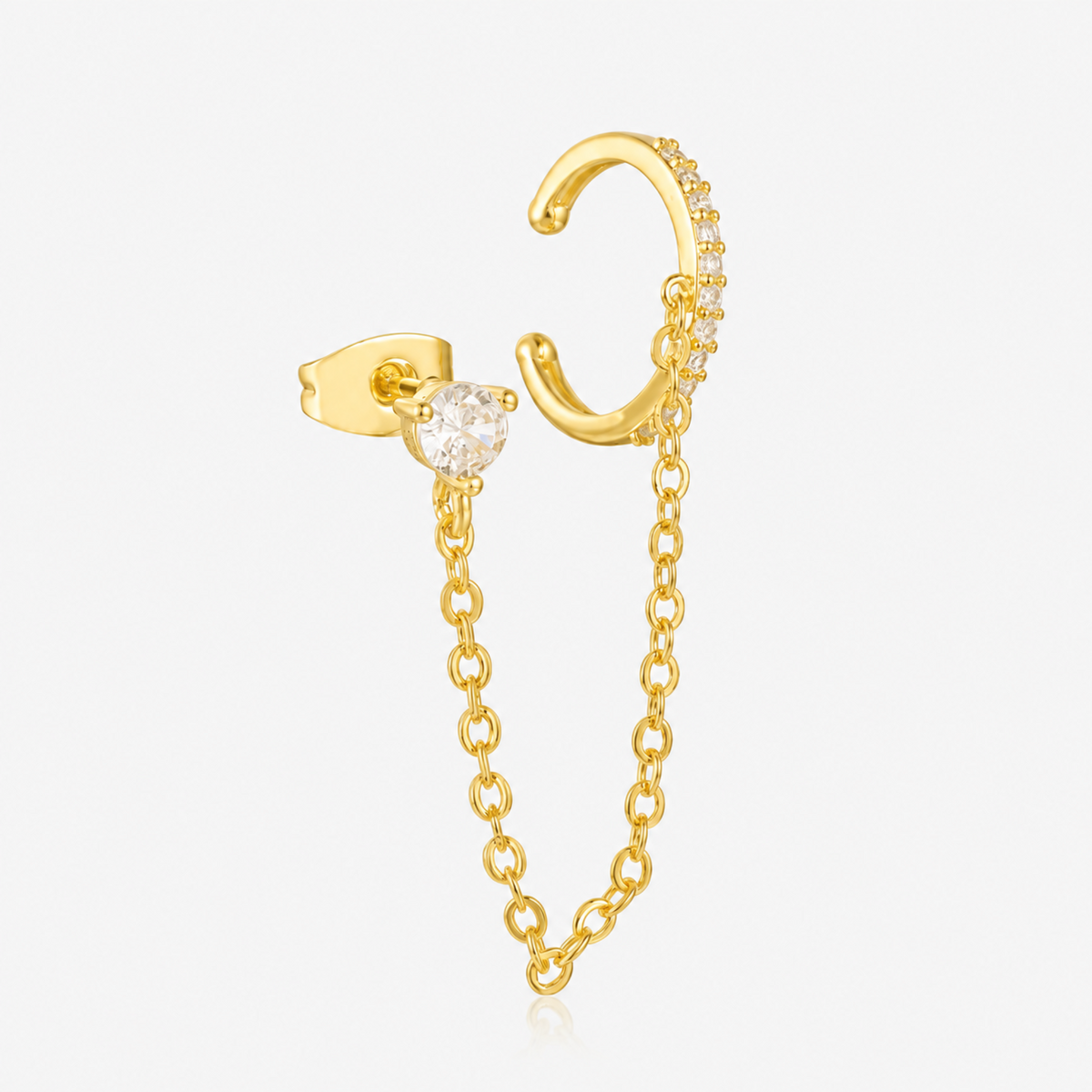
The main types of earrings are studs, flat backs, hoops, huggies, drops, dangles, chandeliers, threaders, ear climbers, ear cuffs, ear jackets and clip ons. Most of them fasten with one of eight backs: push backs, screw backs, flat back discs, latch backs, lever backs, French hooks, hinged snaps or clips.
This guide names each style, shows which back it usually uses, and ranks the backs by security and comfort so you can pick earrings that stay put and feel good.
Types of Earrings at a Glance
Earring types differ in two ways: how the earring looks on the ear and how it attaches. The table pairs each style with its usual back.
| Earring type | What it looks like | Usual back or closure | Best for |
|---|---|---|---|
| Stud | Single stone or shape that sits on the lobe | Push back or screw back | Everyday, first lobe piercings once healed |
| Flat back | Stud with a flat disc behind the ear | Threaded or threadless flat disc | Sleeping, cartilage, stacks |
| Hoop | Open or closed circle through the piercing | Hinged snap, latch or click post | Day to night |
| Huggie | Small, thick hoop that hugs the lobe or rim | Hinged snap | Stacks, upper ear |
| Drop | Short charm that hangs below the lobe without moving much | Push back or lever back | Work and events |
| Dangle | Longer piece that swings freely | French hook or lever back | Statement looks |
| Chandelier | Tiered, branching dangle | French hook or lever back | Formal events |
| Threader | Thin chain pulled through the piercing | The chain itself, with a bar or post | Minimal, airy look |
| Ear climber | Curved stud that climbs up the ear edge | Push back | Faking a multi piercing look |
| Ear cuff | Band that clips around cartilage | None, no piercing needed | Upper ear style without a piercing |
| Ear jacket | Stud plus a back piece that shows below the lobe | Decorative jacket back | Two in one front and back look |
| Clip on | Earring held by a hinged clip | Clip or screw clip | Unpierced ears |
Stud earrings are the most searched earring style in the United States, with about 60,500 monthly searches, followed by flat back earrings at 49,500, clip on earrings and ear cuffs at 33,100 each, and huggie earrings at 22,200. Search demand shows that comfort focused and no piercing styles now rival the classic stud (DataForSEO, 2026).
Studs and Flat Back Earrings
A stud is the simplest earring type: a single decorative front on a straight post. A flat back earring replaces the bulky push back with a flat disc, so nothing pokes the side of your head on a pillow or a phone.
Flat backs are the default for cartilage and for anyone who sleeps in earrings. Our post on why flat back earrings are your new bestie covers the comfort case, and you can shop flat back earrings and classic stud earrings side by side.
Hoops and Huggies
Hoops are circular earrings that pass through the piercing, and huggies are small, chunky hoops that sit snugly against the ear. Hoops range from tiny to shoulder grazing, while huggies stay close to the lobe or rim.
Use the hoop earring size guide to choose a diameter, read what huggie earrings are for fit tips, and compare the two classics in stud vs hoop earrings. Then browse hoop earrings and huggies.
Drop, Dangle and Chandelier Earrings
Drop earrings hang just below the lobe and stay fairly still, while dangle earrings are longer and move freely. Chandelier earrings are a dressier dangle with tiers or branches that catch the light.
The difference matters for weight and back choice: longer pieces pull on the lobe, so a lever back or a secure French hook helps. Our drop vs dangle earrings guide goes deeper, and the drop earrings collection shows the range.
Threaders, Climbers, Cuffs and Jackets
Threaders, ear climbers, ear cuffs and ear jackets are the styles that turn one piercing into a full ear look. A threader is a fine chain pulled through the hole, an ear climber is a curved stud that runs up the ear edge, an ear jacket adds a second element behind the lobe, and an ear cuff wraps the cartilage with no piercing at all.
Hybrids mix them: the Hooked On You Earring/Earcuff links a stud to a cuff with a chain. Explore more in the ear cuffs collection.
Types of Earring Backs Explained
Earring backs fall into eight common types, and they trade security against convenience. Threaded and hinged closures cannot slide off a post, so they hold better than friction backs.
| Earring back | How it works | Security | Comfort for sleeping | Common on |
|---|---|---|---|---|
| Push back (butterfly or friction) | Metal clutch slides onto a smooth post | Basic; can loosen over time | Low | Everyday studs |
| Screw back | Back twists onto a threaded post | High | Low to medium | Valuable studs, kids' earrings |
| Flat back disc (threaded or threadless) | Decorative top screws or presses into a post with a flat disc | High | High | Cartilage, sleep friendly studs |
| Latch back | Post snaps into a latch at the back | Medium to high | Low | Hoops, heavier earrings |
| Lever back | Hinged lever closes against a curved wire | High | Low | Drops and dangles |
| French hook (fish hook) | Open wire hangs through the hole | Low without a rubber stopper | Low | Dangles, chandeliers |
| Hinged snap | Hinged bar clicks into the hoop | High | Medium to high (small sizes) | Huggies, small hoops |
| Clip | Spring hinge pinches the lobe | Medium | Low | Unpierced ears |
Silicone and locking backs are add ons rather than separate types: they slide onto a standard post for extra grip. They help with heavier studs or sports, but check them often, because a worn back loses its hold.
How to Choose Earrings and Backs for Your Ears
Choose the earring back for where the piercing is and how healed it is, then choose the style. A fresh piercing, a healed lobe and a cartilage piercing each need different jewelry.
The American Academy of Dermatology names earrings and earring backs among the biggest culprits behind nickel allergy. The AAD advises wearing only jewelry that is nickel free, hypoallergenic, or made from metals such as surgical grade stainless steel, 18, 22 or 24 karat yellow gold, pure sterling silver or platinum (American Academy of Dermatology, accessed October 2026).
Read the full AAD nickel allergy guidance, and our hypoallergenic guide for sensitive ears. Check each product page for its metal and back type before you buy.
The Association of Professional Piercers states that gold plated, gold filled and vermeil jewelry is not acceptable for fresh piercings, and prefers internally threaded jewelry so that the part passing through the skin is smooth. Fashion earrings and decorative backs therefore belong in healed piercings, not new ones (Association of Professional Piercers, accessed October 2026).
See the APP standards for initial piercing jewelry. Cleveland Clinic notes that earlobe piercings heal in about 6 to 8 weeks and cartilage in 6 to 12 months, so wait out that window before switching styles (Cleveland Clinic ear piercing guide).
For placement ideas, see our simple ear map of piercing types, and match shapes to your features with the guide to the best earrings for your face shape.
Frequently Asked Questions About Earring Types and Backs
How many types of earrings are there?
Most jewelry guides group earrings into about 10 to 12 main types: studs, flat backs, hoops, huggies, drops, dangles, chandeliers, threaders, ear climbers, ear cuffs, ear jackets and clip ons. Many earrings blend two types, such as a huggie with a charm or a stud chained to a cuff. Knowing the type tells you the likely back, the weight and whether the piece suits a lobe, cartilage or an unpierced ear.
What are the most popular earring styles?
Studs are the most popular earring style by US search demand, with about 60,500 monthly searches, followed by flat back earrings at 49,500 and ear cuffs and clip ons at 33,100 each (DataForSEO, 2026). Huggies follow at 22,200. Studs and huggies work every day, flat backs win on comfort, and cuffs add an upper ear look with no new piercing. Most people build a stack that mixes several of these styles.
What kind of earring backs are most secure?
Screw backs, threaded flat back discs, lever backs and hinged snaps are the most secure earring backs, because each locks mechanically instead of relying on friction. Push backs are the most common but can loosen with wear, and French hooks can slip out without a rubber stopper. For valuable or heavier earrings, choose a screw back or lever back. Replace any back that feels loose, and add a silicone back for extra grip on push back studs.
Are flat backs better than butterfly backs?
Flat backs are better than butterfly backs for comfort and security, while butterfly backs are easier to change. A flat back sits flush behind the ear, so it does not dig in when you sleep or wear a headset, and its threaded or threadless post holds firmly. A butterfly back slides on by friction and can loosen. For cartilage and sleeping, choose flat backs; for quick daily swaps on healed lobes, butterfly backs work well.
What are the different types of earring backs called?
The 8 common earring backs are push backs (also called butterfly or friction backs), screw backs, flat back discs, latch backs, lever backs, French hooks (also called fish hooks), hinged snaps and clips. Silicone and locking backs are add ons that slide onto a standard post for extra grip. The name usually describes how the back closes, which is the best clue to how secure it will be.
Find your next favorite pair in the EVRY earrings collection.

