


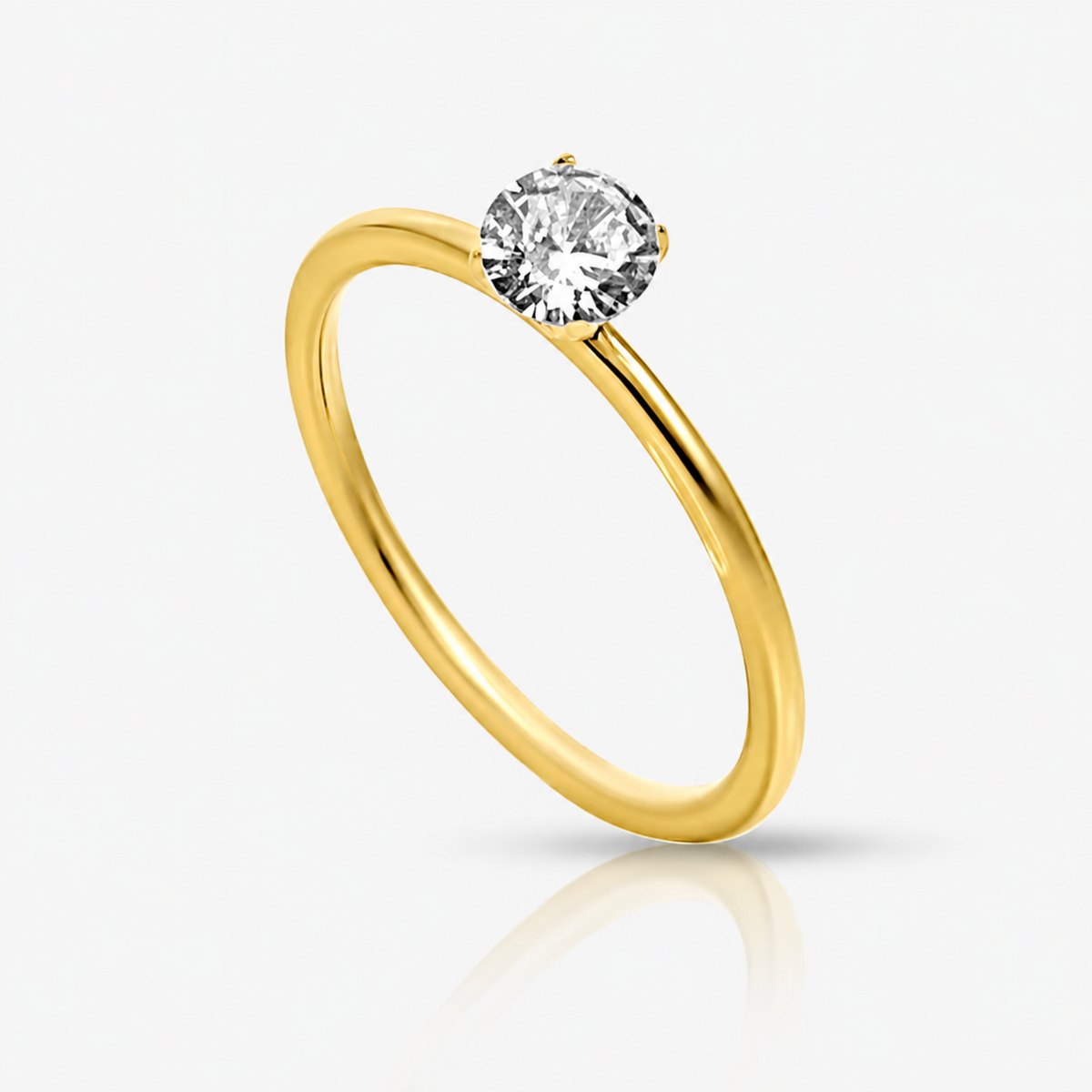
Cubic zirconia (CZ) is a lab made crystal of zirconium dioxide, stabilized in a cubic structure, that looks like diamond at a fraction of the cost. CZ ranks 8 to 8.5 on the Mohs hardness scale, shows slightly more fire than diamond and can be made colorless or in almost any color.
Cubic zirconia is not a diamond and not a natural gem. It is a diamond simulant: a material that imitates diamond's look while having a completely different chemistry and structure.
What Is Cubic Zirconia Made Of?
Cubic zirconia is made of zirconium dioxide (ZrO2) plus a small amount of stabilizer, usually yttrium oxide, sometimes calcium oxide. The stabilizer locks the crystal into its cubic form, which is what makes it hard, clear and brilliant.
GIA classifies CZ as a simulant, meaning a material that looks like another gem but has a different chemical composition, crystal structure and optical properties. Read GIA's overview of imitation and simulant gems.
Cubic zirconia has a refractive index of 2.15 to 2.18, a dispersion of 0.058 to 0.066, a hardness of 8.0 to 8.5 and a specific gravity of 5.6 to 6.0, according to a 1981 study by Kurt Nassau in Gems and Gemology. Those optical numbers explain why a well cut cubic zirconia shows strong sparkle and colorful fire (GIA, Gems and Gemology, 1981).
The name causes confusion. "Cubic zirconium" is a misnomer, since zirconium is a metal, and cubic zirconia is also different from zircon, a natural gemstone and an alternate December birthstone.
How Cubic Zirconia Is Made
Cubic zirconia is grown by a method called skull melting. Powdered zirconium oxide is heated inside a water cooled metal chamber until it melts, and the cooler outer crust forms its own container, or "skull."
Pure zirconium dioxide melts at about 2,750°C (4,982°F), too hot for ordinary crucibles. GIA explains that the melt is then slowly moved away from the heat source, so crystals grow from the bottom until the whole melt solidifies.
| Year | Milestone |
|---|---|
| 1937 | German mineralogists identify tiny natural cubic zirconia grains in a mineral sample |
| 1969 | Crystals large enough to facet are first produced |
| 1972 | Scientists at the Lebedev Physical Institute in Moscow develop practical skull melting |
| 1976 | Colorless cubic zirconia is first marketed as a diamond imitation |
| 1980 | Production reaches about 60 million carats of rough a year |
The timeline comes from Nassau's Cubic Zirconia: An Update, published by GIA in Gems and Gemology, Spring 1981. Within a few years of its launch, CZ replaced earlier simulants as the dominant diamond imitation.
Colored cubic zirconia comes from the same process. Manufacturers add small amounts of metal compounds, called dopants, to the melt, and GIA notes that CZ can be produced in almost any color. Nassau's study reports that colored CZ rough took off with cutters after the 1979 Tucson gem show, and that colored stones look especially lively because the high refractive index and dispersion carry through the color. That is why pink, green and blue CZ often read as brighter than many natural colored gems of a similar shade.
Cubic Zirconia vs Diamond and Other Alternatives
Cubic zirconia looks most like diamond, but it is softer, heavier and shows more colored fire. The table compares CZ with diamond and the other stones shoppers consider.
| Stone | What it is | Mohs hardness | Refractive index | Specific gravity | Relative cost |
|---|---|---|---|---|---|
| Cubic zirconia | Lab made zirconium dioxide (simulant) | 8 to 8.5 | 2.15 to 2.18 | 5.6 to 6.0 | Lowest |
| Natural diamond | Mined carbon | 10 | 2.42 | 3.52 | Highest |
| Lab grown diamond | Lab made carbon, a real diamond | 10 | 2.42 | 3.52 | Lower than natural diamond |
| Moissanite | Lab made silicon carbide (simulant) | 9.25 | Doubly refractive; more than twice diamond's fire | Not compared here | Moderate |
| White sapphire | Colorless corundum | 9 | Less brilliant than diamond | Not compared here | Moderate |
Diamond data comes from GIA's diamond description. Moissanite, white sapphire and lab grown diamond hardness come from GIA's guide to diamond alternatives, which notes that lab grown diamonds are real diamonds, unlike simulants.
GIA reports that cubic zirconia has slightly more fire but less brilliance than diamond, ranks 8.5 on the Mohs scale compared with diamond's 10, and that colorless cubic zirconia may yellow over time. GIA also describes cubic zirconia as very affordable, which makes CZ a practical choice for fashion pieces and travel jewelry (GIA, accessed October 2026).
How to Tell Cubic Zirconia From a Diamond
The most reliable way to tell cubic zirconia from diamond is a test by a trained gemologist, but a few clues help at home. GIA states that simulants like CZ are easily identified by their optical and physical properties.
- Weight. A CZ of the same size is roughly 1.6 to 1.7 times heavier than a diamond, based on specific gravities of 5.6 to 6.0 versus 3.52.
- Fire. CZ often flashes more rainbow color, which some people find looks less natural.
- Wear. After years of wear, CZ facets can show scratches and a cloudy look, while diamond resists scratching.
- Paperwork. A diamond of any significant size usually comes with a grading report; CZ does not.
See GIA's explainer on simulated diamonds for more detail.
Is Cubic Zirconia Good for Everyday Jewelry?
Cubic zirconia is a good choice for everyday fashion jewelry, especially earrings, pendants and stacking pieces. At 8 to 8.5 on the Mohs scale, CZ is harder than quartz and most dust, so it resists scratching better than many colored gems.
The trade offs show over years, not days. CZ scratches more easily than diamond, can look cloudy when film and fine scratches build up, and colorless CZ may yellow over time, according to GIA. Rings take the most knocks, so expect to refresh a daily CZ ring sooner than a pair of studs.
CZ sparkle suits styles built for shine. Browse tennis bracelets, stud earrings and it girl bling, and check each product page for its stone details. Pair studs and hoops using our stud vs hoop earrings guide.
How to Clean and Care for Cubic Zirconia
Clean cubic zirconia with warm water, a few drops of mild soap and a soft toothbrush, then rinse and dry with a lint free cloth. Lotion and skin oil dull CZ quickly, so a regular clean brings most of the sparkle back.
GIA lists ultrasonic and steam cleaners as safe for cubic zirconia, but the setting may not be. Plated metal and glued stones need a gentler routine, so follow the care for the metal as well as the stone. Store CZ pieces apart from harder stones and each other to prevent scratches.
Frequently Asked Questions About Cubic Zirconia
Is cubic zirconia a fake diamond?
Cubic zirconia is a diamond simulant, so it imitates diamond rather than being one. CZ is lab made zirconium dioxide, while diamond is pure carbon. GIA describes simulants as materials with a different chemical composition, crystal structure and properties from the gem they imitate. Calling CZ "fake" is fair only if it is sold as diamond; sold honestly as CZ, it is a real material in its own right.
What is the downside of cubic zirconia?
The main downsides of cubic zirconia are lower hardness and long term wear. CZ ranks 8 to 8.5 on the Mohs scale, versus 10 for diamond, so facets can scratch and look cloudy after years of daily wear. GIA also notes that colorless CZ may yellow over time and has less brilliance than diamond. It has little resale value, so buy it for looks, not investment.
Is cubic zirconia a real diamond?
No. Cubic zirconia is not a real diamond, natural or lab grown. A lab grown diamond is carbon with the same structure, hardness of 10 and refractive index of 2.42 as a mined diamond. Cubic zirconia is zirconium dioxide with a refractive index of 2.15 to 2.18 and a specific gravity of 5.6 to 6.0, so a gemologist can separate the two easily.
Is cubic zirconia worth anything?
Cubic zirconia has a low intrinsic value, because it is mass produced; output reached about 60 million carats of rough a year by 1980, according to Gems and Gemology. GIA calls CZ very affordable. The value of a CZ piece sits mostly in its design and metal, not the stone, so it is worth buying for style and sparkle rather than as a store of value.
Does cubic zirconia get cloudy?
Cubic zirconia can look cloudy over time, mostly from a film of lotion, soap and skin oil, and after years from fine surface scratches. A clean with warm soapy water and a soft brush removes film in minutes. Scratches are permanent, because CZ ranks 8 to 8.5 on the Mohs scale, below diamond's 10, so storing pieces separately is the best prevention.
Ready to add some sparkle? Shop sparkle styles like the Petite Sparkle Ring and the Icy Tennis Bracelet, or explore the full EVRY rings collection.

